
Formwork Compliance Guide: Acceptance Criteria, Specs, and Regional Requirements
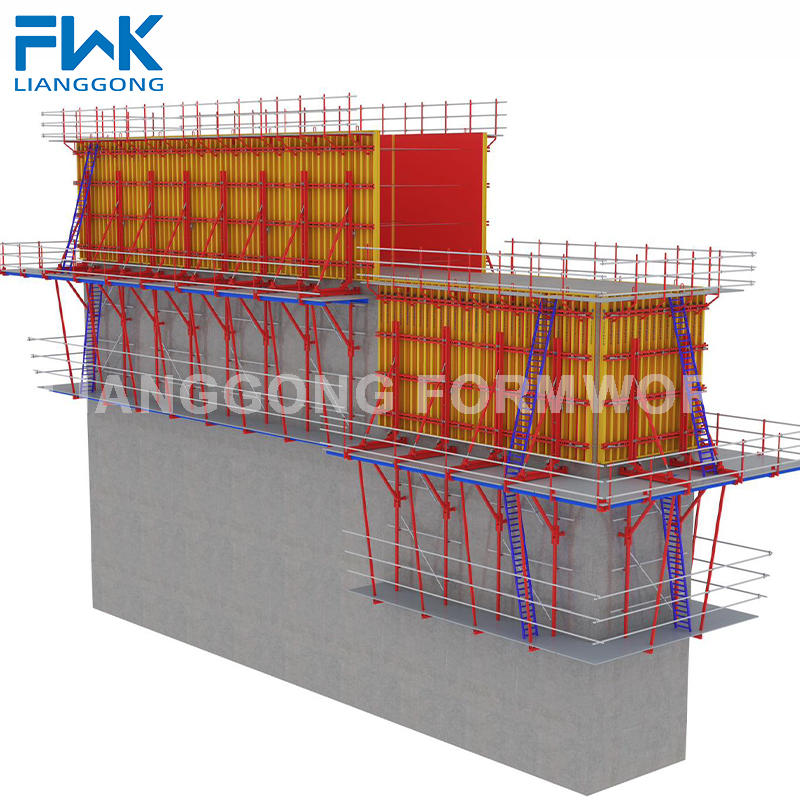
Climbing formwork is accepted against measurable criteria such as operating width and specified protection height, not against a general compliance claim.
Formwork compliance is not established by a single certificate. It is established by a chain of evidence: purchasing terms that define what will be accepted, documentation that matches those terms, product specifications that can be measured at delivery, and a documented check against the requirements that apply where the project is built.
Contractors and procurement teams usually manage those four layers in four different places. The commercial team writes the purchase order. The engineering team reviews drawings. The site team receives the panels. The compliance file is assembled last, often after a shipment has been booked.
This guide answers the questions that arise when acceptance criteria have to be aligned with project and regional requirements. It describes verifiable product facts and treats regional requirements as verification checkpoints the buyer confirms, not as approvals a supplier can assert on the buyer's behalf.
Problem Definition: Why Formwork Compliance Breaks Down at Procurement
Three failure patterns account for most of the friction between formwork suppliers and buyers.
1. A falsework standard is used as the formwork product standard
BS EN 12812:2008 specifies performance requirements and limit state design methods for two design classes of falsework. The standard itself notes that it does not specify requirements for formwork, although formwork may be part of the falsework construction. A purchase order that cites BS EN 12812 as the product standard for a wall, column, or slab formwork system is citing a document whose scope does not cover the product being purchased.
2. The certificate does not match the product
A management system certificate carries a defined scope. Where the scope covers hydraulic auto-climbing formwork and cantilevered climbing formwork for construction, that certificate does not by itself demonstrate conformity of a slab panel, a steel prop, or a trench box. Matching scope to the actual bill of materials is a procurement task, not a supplier marketing task.
3. Regional requirements are accepted as supplier claims
Regional requirements vary by jurisdiction, project type, and client specification. A supplier can state which documents it holds and what those documents cover. Only the buyer, working with the temporary works designer or engineer of record, can confirm that those documents satisfy the applicable local requirement.
Industry Background: Why No Single Document Covers Formwork
Formwork is a temporary structure built to shape and support concrete until it can carry itself. Its compliance profile therefore spans several domains at once: structural design, material supply, fabrication quality, site assembly, and occupational safety.
The market context explains why buyers face so many system choices. The global formwork market was valued at USD 7.91 billion in 2025, with Asia Pacific accounting for 42.8% of revenue. Aluminum formwork recorded 54% utilization in the real estate industry in 2025, and aluminum systems are reported to achieve reusability of 300+ cycles. Those figures describe scale and material adoption. They do not describe compliance, and they should not be read as evidence that any system is approved in any particular market.
What the figures do indicate is that buyers are choosing between material paths — timber beam, steel frame, aluminum frame, plastic — and each path carries a different documentation profile. A steel-framed system raises questions about structural steel execution and welding quality. A timber beam system raises questions about engineered timber beams and plywood facing. An aluminum system raises questions about extrusion, machining, and panel assembly.
The standards landscape reflects that fragmentation. BS EN 12812 addresses falsework design. The note attached to that standard references EN 13377 for timber formwork beams and EN 1065 for props as separately standardized products. There is no single document a supplier can present as "formwork compliance." There is a set of documents, each with a defined scope — and the buyer's job is to assemble and verify that set before the order is placed.
Detailed Solution: A Four-Layer Acceptance Framework
Aligning acceptance criteria with project and regional requirements works best when the work is split into four layers, each with a different owner and a different evidence type.
Layer 1 — Purchasing terms and acceptance criteria
The purchase order is the document that decides what "accepted" means. A compliance-ready order should specify five things:
- Product identification. System name and model designation exactly as they appear in the supplier's catalogue — for example Cantilever Climbing Formwork FWK-CB 240 or Early Stripping Slab Formwork FWK-DHF175.
- Configuration. Panel dimensions, component list, connection hardware, and any project-specific adaptation.
- Documentation deliverables. Which certificates, drawings, assembly instructions, and inspection records are required, and in which language.
- Acceptance method. Dimensional check, panel weight check, visual inspection, documentation review, and who signs off each one.
- Validity window. Every certificate must remain valid through the delivery and installation period, not just at the date of quotation.
Layer 2 — Documentation checks
Documentation is where most compliance files are won or lost. Each document must be read for scope, standard, issuing body, and validity, not simply collected.

Technical documentation review is the step where certificate scope is matched against the actual bill of materials.
Using FWK Lianggong Formwork — the trading identity of Yancheng Lianggong Formwork Co., Ltd., a formwork and scaffolding manufacturer established in 2010 in Yancheng, Jiangsu Province, China — the document set illustrates what a buyer should expect to see and verify:
- Quality management system certificate. Certificate 03425Q50028R4M, issued by BEIJING HANGXIE CERTIFICATION CENTER CO., LTD. against GB/T 19001-2016 / ISO 9001:2015, issued 2025-01-08 and valid to 2028-03-03. The stated scope is hydraulic auto-climbing formwork and cantilevered climbing formwork for construction.
- Welding quality management system certificate. Certificate 23/1014-3834, issued by SGS Italia S.p.A. against EN ISO 3834-2:2021, issued 2023-12-19 and valid to 2026-12-18. The stated scope is fusion welding of steel structures parts and components.
- Factory production control certificate for structural steel. Certificate 1381-CPR-889, issued by SGS Italia S.p.A. against EN 1090-1:2009+A1:2011 and EN 1090-2:2018+A1:2024, issued 2023-12-19 and valid to 2026-12-18. The stated scope is execution of structural steel components, for the EU market.
- Environmental and occupational health and safety certificates. Certificate 0342026E0058R101 against GB/T 24001-2016 / ISO 14001:2015 and certificate 0342026S0061R101 against GB/T 45001-2020 / ISO 45001:2018, both issued 2026-02-04 and valid to 2029-02-09.
- Product-specific conformity documentation where it exists. For the trench box line, the LG-100 Trench Box EU ECM Technical Documentation Compliance Certificate OP250411.YLFD013, issued 2025-05-09 and valid to 2030-05-08, cites EN 13331-1:2002, EN 13331-2:2002, EN 12811-1:2003 and EN 1997-1:2024.
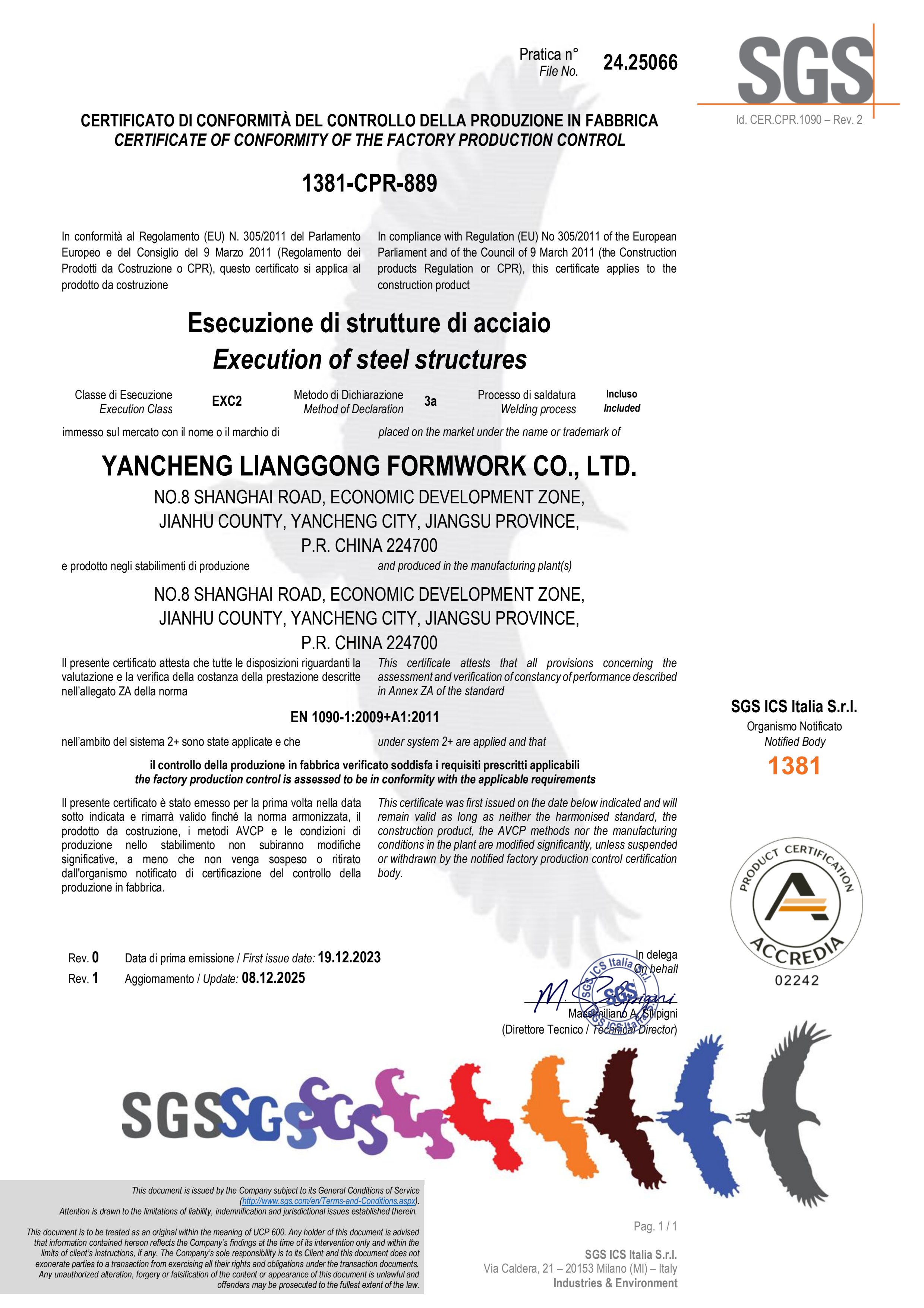
A factory production control certificate is only meaningful when its scope, standard edition, and validity date are checked against the order.
Layer 3 — Product-level specifications
Specifications are the part of compliance that can be measured on the loading dock. The acceptance list below covers the values that appear in the published product data for the systems in this guide.
- H20 Timber Beam Formwork — composition: H20 timber beam, plywood facing, steel waler, and flange claw. Panel weight: 65 kg/m².
- Cantilever Climbing Formwork FWK-CB 240 — bracket height 10–15 m, operating width 900 mm, and a specified protection height.
- Early Stripping Slab Formwork FWK-DHF175 — panel weight 24 kg/m², max panel size 1.8 m × 1.2 m, panel depth 192 mm, max permissible slab thickness 380 mm, plywood thickness 12 mm.
- Skydeck FWK-SKYDECK — max load capacity 90 kN/m², panel weight 18 kg/m², max panel size 1.5 m × 0.75 m.
- Single-Side Bracket — max cast height at one time 7.5 m.
- Trench Box FWK-ST100 / FWK-AT100 / FWK-SMH100 / FWK-AMH100 — maximum trench depth 5.6 m, pipe clearance height 1.3 m, trench width 1.20–4.60 m.
- Steel Props — AEP-30 working load 30 kN, AEP-20 working load 20 kN, Universal 60/48 working load 15 kN.
- Tunnel Formwork for Housing FWK-TUN 63 — weight 75 kg/m², normal height 3 m, cycle time 3 days per floor.

Working load and support height are among the few formwork figures a site team can physically verify on delivery.
Layer 4 — Regional requirements as verification checkpoints
This is the layer where buyers most often over-rely on the supplier. A supplier can document what it holds. It cannot certify a project's compliance in a jurisdiction on the buyer's behalf. The practical approach is to convert regional requirements into a checklist that the buyer's temporary works designer answers.
- Which local regulation, code, or client specification governs temporary works on this project?
- Which product standard does that regulation reference, and does the supplier's document cite the same edition?
- What language, notarization, or legalization requirements apply to the certificate before the authority will accept it?
- Which party holds responsibility for temporary works design approval, and does the supplier's documentation support that submission?
- What inspection regime applies at delivery and during erection, and who witnesses it?
Step-by-Step Breakdown: An Eight-Step Acceptance Workflow
The workflow below sequences the four layers into an order that procurement teams can run before the purchase order is issued rather than after the container has shipped.
Step 1 — Define the system and its boundary
Name the exact system and the scope of supply. A slab package and a climbing package have different documentation profiles. Decide whether formwork and falsework are being procured together or separately, because the standards that apply are not interchangeable.
Step 2 — Build the document request list before the RFQ
Issue the documentation list with the enquiry, not after the quotation. Suppliers who know that scope, standard, and validity will be checked prepare more accurate files the first time.
Step 3 — Match certificate scope to the bill of materials
Read each certificate for the exact product wording in its scope. A welding quality certificate covering fusion welding of steel structures parts and components supports a steel assembly discussion. It does not, on its own, address a plywood facing specification.
Step 4 — Check validity dates against the delivery schedule
Compare the certificate end date with the planned delivery and installation window. Where the gap is narrow, request the renewal plan in writing.
Step 5 — Confirm the measurable product specifications
Record the values from Layer 3 in the order. Panel weight, operating width, protection height, working load, and maximum cast height are all checkable at goods receipt.
Step 6 — Map regional requirements with the temporary works designer
Produce a written mapping: requirement, referenced standard, supplier document, gap, and owner. This mapping is the document an auditor or client representative will ask for.
Step 7 — Validate through sample and pre-shipment inspection
Physical validation closes the loop between paper and product. Check panel dimensions, weight, connection details, and finishing against the approved drawings before the balance of the order is released.
Step 8 — Record acceptance at delivery
Sign off each acceptance criterion separately. A single "received in good order" signature collapses the four layers back into one and removes the evidence trail the project may need later.
Use Cases: Where Acceptance Criteria Change by Application
High-rise cores and shear walls
Climbing formwork is used for vertical concrete structures. On high-rise cores and shear walls, acceptance centres on operating width, protection height, bracket height, and anchor documentation. The FWK-CB 240 configuration specifies a 900 mm operating width, a bracket height of 10–15 m, and a defined protection height — three values that belong in the purchase order, not only in the brochure.
Cast-in-place floor slabs
Slab systems are accepted largely on geometry and thickness limits. For the FWK-DHF175 early stripping system, the 380 mm maximum permissible slab thickness, 1.8 m × 1.2 m maximum panel size, 192 mm panel depth, and 12 mm plywood thickness define what the site can actually build with the delivered package.
Trench and underground drainage work
Trench work adds a safety-documentation layer. The trench box range is specified to a maximum trench depth of 5.6 m, a pipe clearance height of 1.3 m, and a trench width range of 1.20–4.60 m. Where the EU market applies, the LG-100 Trench Box EU ECM certificate OP250411.YLFD013 provides an example of product-specific documentation that a buyer can present, while the buyer still confirms the local applicability.
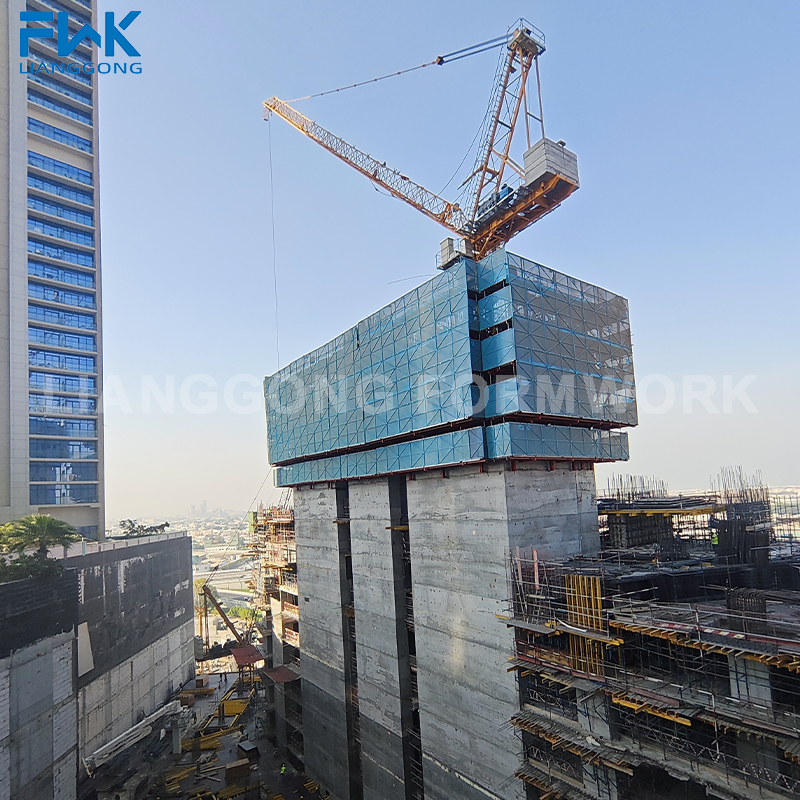
On high-rise cores, climbing system acceptance depends on documented anchor systems, operating width, and protection height.
Dams, bridges, and irregular structures
Infrastructure projects add another variable: adaptability. In the Kalimantan Dam project in Indonesia, an EPC contractor used 100 sets of the H20 Timber Beam Formwork System over a duration of more than ten years. The timber beams and panels could be freely cut and reused on site, which improved material utilisation while the system maintained load-bearing performance during large-volume pours. For acceptance purposes, the relevant point is that the component list and reusability assumptions should be written into the order when a project expects on-site adaptation.
Comparison Table: Acceptance Focus by System Type
| System | Verified specification reference | Primary acceptance focus | Documentation to request |
|---|---|---|---|
| H20 Timber Beam Formwork | H20 timber beam, plywood, steel waler, flange claw; panel weight 65 kg/m² | Component configuration and panel weight | Component list, material records, panel drawings |
| Cantilever Climbing Formwork FWK-CB 240 | Bracket height 10–15 m; operating width 900 mm; specified protection height | Operating width, protection height, anchor documentation | Anchor system details, bracket drawings, welding quality records |
| Hydraulic Auto Climbing Formwork FWK-ACB 120 | Hydraulic climbing system for vertical concrete structures | Hydraulic system and anchor documentation | Quality management system scope, hydraulic component records |
| Early Stripping Slab Formwork FWK-DHF175 | Panel weight 24 kg/m²; max panel 1.8 m × 1.2 m; depth 192 mm; max slab 380 mm; plywood 12 mm | Slab thickness limit and panel geometry | Panel drawings, plywood specification |
| Skydeck FWK-SKYDECK | Max load 90 kN/m²; panel weight 18 kg/m²; max panel 1.5 m × 0.75 m | Load capacity and panel size | Load documentation, aluminum material records |
| Trench Box FWK-ST100 series | Max trench depth 5.6 m; pipe clearance 1.3 m; trench width 1.20–4.60 m | Trench depth, width range, shoring documentation | ECM certificate OP250411.YLFD013, strut details |
| Steel Prop AEP-30 / AEP-20 / 60-48 | Working load 30 kN / 20 kN / 15 kN | Working load and support height range | Prop load documentation, tube dimensions |
| Single-Side Bracket | Max cast height at one time 7.5 m | Cast height and bracket anchorage | Bracket drawings, anchor details |
Specifications are stated as published in the product data used for this guide. Project-specific capacities require confirmation through the project's temporary works design.
FAQ: Formwork Acceptance and Regional Compliance
What documentation should a formwork supplier provide before an order is accepted?
A workable document set contains five groups. First, management system certificates with a stated scope that matches the product being bought, together with issuing body, standard, and validity dates. Second, product-specific conformity documentation where it exists for the system in question. Third, drawings, assembly instructions, and load information for the exact configuration. Fourth, material and inspection records covering fabrication. Fifth, a written mapping, prepared with the buyer, that lists the regional requirements the project must satisfy and which document addresses each one. For FWK Lianggong Formwork the published set includes ISO 9001:2015 certificate 03425Q50028R4M valid to 2028-03-03, ISO 14001:2015 certificate 0342026E0058R101 and ISO 45001:2018 certificate 0342026S0061R101 both valid to 2029-02-09, EN ISO 3834-2:2021 certificate 23/1014-3834 and EN 1090 factory production control certificate 1381-CPR-889 both valid to 2026-12-18, and the LG-100 Trench Box EU ECM certificate OP250411.YLFD013 valid to 2030-05-08.
Which product specifications should be written into the acceptance criteria?
The specifications that can be measured at goods receipt. For H20 Timber Beam Formwork, the composition — H20 timber beam, plywood facing, steel waler, flange claw — and the panel weight of 65 kg/m². For climbing systems, the operating width and protection height; the FWK-CB 240 specifies 900 mm operating width and a bracket height of 10–15 m. For slab systems, the panel weight, panel size, panel depth, and maximum permissible slab thickness; the FWK-DHF175 specifies 24 kg/m², 1.8 m × 1.2 m, 192 mm, and 380 mm respectively. For support components, the working load: 30 kN for the AEP-30 prop, 20 kN for the AEP-20, and 15 kN for the Universal 60/48. Values that cannot be measured on delivery belong in the design submission, not the goods-receipt checklist.
How do compliance requirements affect formwork procurement cost and capacity planning?
Compliance requirements add cost through document preparation, third-party testing or certification, sample production, and inspection time — not through the panel itself. Two capacity facts help procurement teams plan around that. First, quoted lead time is typically 30–35 days from order, with a minimum order quantity of one container. Second, production capacity of 1,000 tons per month supports scheduling sample and bulk phases in sequence rather than in parallel. Buyers who need a sample validated before the full order should therefore build the sample phase into the delivery schedule at the enquiry stage, since a sample validated after the bulk order is booked does not reduce delivery risk.
How should a buyer validate a formwork system before full-scale acceptance?
Validation has three parts that should run in order. The first is document validation: scope, standard edition, and validity checked against the bill of materials. The second is physical sample validation: panel dimensions, panel weight, connection details, and surface finish compared with the approved drawings — a supplier sample room is normally the setting for this step. The third is pre-shipment inspection against the same checklist, witnessed by the buyer's representative where the project requires it. FWK Lianggong Formwork supports OEM and ODM configurations with logo and size customisation, runs 100% testing as its stated quality control method, and offers on-site support and remote guidance for installation — three capabilities that make a structured validation sequence practical rather than theoretical.
How long does compliance review add to formwork lead time, and how can it be shortened?
Compliance review does not have to be additive if it runs in parallel with production planning. The quoted production lead time is 30–35 days, so a review that begins at the RFQ stage — with the document list issued alongside the enquiry and validity dates checked before the order is placed — can conclude before production starts. The reviews that do extend a schedule are usually the ones started after the order, when a certificate scope mismatch or an expiring validity date forces a document replacement cycle. For projects in the Middle East, Europe, Africa, North America, or South America, where FWK Lianggong Formwork reports 70% of its sales, the practical next step is to send the project's requirement list with the enquiry so that the document set and the sample plan are confirmed in writing before the purchase order is issued.
Conclusion: Compliance Is a File the Buyer Owns
Formwork acceptance is not a single event and not a single certificate. It is a file assembled from purchasing terms, scoped documentation, measurable specifications, and a regional mapping the buyer controls. The supplier's contribution is accurate documents with clear scope and current validity. The buyer's contribution is the discipline of checking scope against the bill of materials, checking dates against the delivery schedule, and confirming regional applicability with the party that carries design responsibility.
Where regional requirements are uncertain, the correct position is not to accept a supplier statement of approval. It is to write the requirement down, identify which document addresses it, and record the answer — or the gap — before the container leaves the factory.
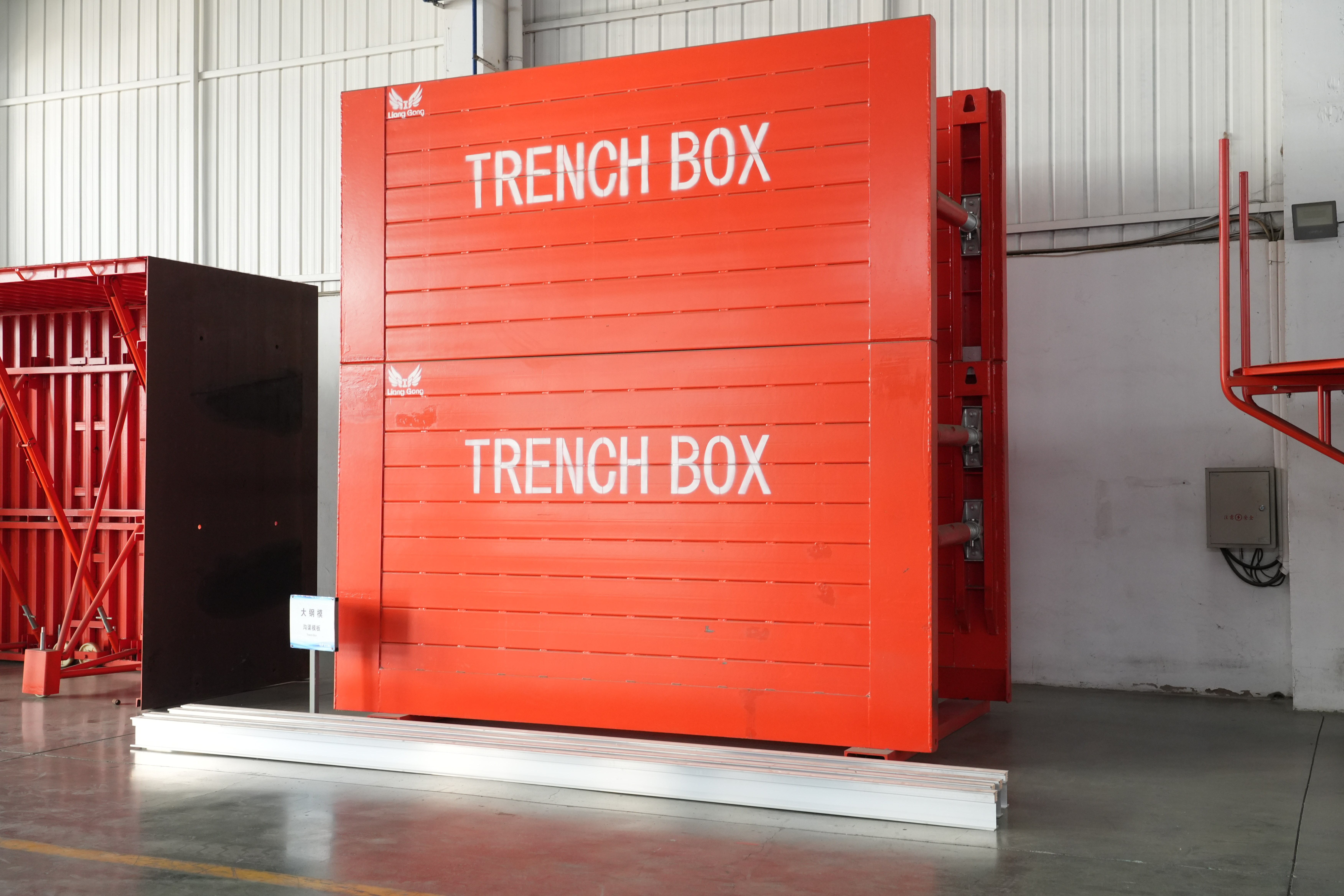
Physical validation in a sample room closes the gap between documentation and the product that will arrive on site.
Next Step: Request the Document Set and a Sample
FWK Lianggong Formwork supplies formwork and scaffolding systems from Yancheng, Jiangsu Province, China, with a 12,870 m² factory, 230 employees, 45 R&D staff, and annual output of 12,000 tons. To align a project's acceptance criteria with the documentation available, send the requirement list and the system shortlist together.
Download the product catalogue: FWK Lianggong Formwork Catalogue (PDF)
Website: www.lianggongformwork.com
Email: sales01@lianggongform.com | Tel: +86 18201051212 | WhatsApp: +86 18201051212
This guide describes published product specifications and document scopes for the systems named. It does not constitute a certification of compliance for any specific project or jurisdiction. Project-specific acceptance requires review by the responsible temporary works designer and confirmation against the requirements in force at the project location.
Have Questions or Need More Details?
Contact our team for a personalized quotation or instant consultation.
Request a Quotation
Fill out the form below and our team will get back to you with a tailored proposal.
WhatsApp Direct Chat
Prefer to chat in real-time? Message us on WhatsApp for instant assistance & quick answers.
- Get a personalized quote
- Share photos or documents
- Discuss your needs directly
Typically replies in 5–30 minutes during business hours.