
Formwork Comparison 2026: FWK Lianggong vs Conventional H20 and B-FORM Systems
Decision-stage comparison for procurement teams, contractors and engineers. Prepared in August 2026.
This guide compares two formwork families produced by Yancheng Lianggong Formwork Co., Ltd. (brand: FWK Lianggong Formwork) with conventional alternatives: H20 timber beam formwork and steel frame formwork marketed as B-FORM. It is written for buyers who have already shortlisted suppliers and now need to compare system performance, lifetime cost, installation speed, maintenance burden and risk control before placing an order. FWK Lianggong Formwork, established in 2010 and based in Yancheng, Jiangsu, China, is a manufacturer of formwork and scaffolding systems. The product range includes H20 timber beam formwork, steel formwork, steel frame formwork, aluminum formwork, aluminum frame formwork, plastic formwork, hydraulic auto-climbing formwork, cantilever climbing formwork, drophead slab formwork, Skydeck, box culvert formwork, trench box, tunnel formwork, single-side bracket, steel props, ring-lock scaffolding system and plywood. Approximately 70% of output is exported to North America, South America, the Middle East, Europe and Africa. The comparison below is based on FWK Lianggong's published system data and independent market context. It does not replace project-specific engineering review, but it gives procurement teams a common framework for asking the right questions.
The Buying Problem: Comparing Systems Instead of Only Comparing Prices
At the decision stage, the buying problem is not which product is cheaper but which formwork system delivers the lowest cost per safe, compliant concrete placement across the full project program. Conventional formwork often appears lower in initial price, but may require more frequent panel replacement, heavier site labor, longer installation cycles and higher maintenance spending. Two products are frequently compared in this situation:
- H20 timber beam formwork — a beam-and-panel system used for wall, slab and column formwork, and for special-shaped structures.
- Steel frame formwork (B-FORM) — a modular framed panel system used for high-rise walls, core walls, shear walls and columns.
This guide evaluates both against conventional formwork using criteria that matter in final supplier selection: turnover rate, material quality, installation efficiency, maintenance cost, and the supplier's inspection and risk-control process.
Industry Background: Market Signals That Influence Formwork Decisions
The global formwork market is large and still expanding. Dataintelo estimates the market reached USD 7.91 billion in 2025 and projects USD 12.66 billion by 2034. Fortune Business Insights reports that Asia Pacific accounted for approximately 54.7% of concrete formwork revenue in 2025. Dataintelo also reports that engineered formwork — modular and reusable systems — held the largest product share at 38.5% in 2025, and that PERI Group and Doka Group together held approximately 22% of the global market. These signals point to a market where engineered systems are becoming the default for professional contractors. For buyers, this means the supplier evaluation should include verification of engineering standards. In the United States, safety requirements for concrete and masonry work, including formwork design and erection, are governed by ANSI/ASSP A10.9-2013 (R2018). In Europe, EN 12812:2008 specifies performance requirements and general design for falsework or shoring. FWK Lianggong Formwork is listed in a verified supplier profile as holding CE (EN 1090-1), ISO 9001 and ISO 3834 certification; buyers should still request current certificates before ordering.
Detailed Solution: FWK H20 Timber Beam Formwork vs Conventional H20 Timber Beam Formwork
FWK Lianggong's H20 timber beam formwork system is designed around standardized H20 timber beams and high-density panels. The company's comparison data describes the FWK version as lightweight, adaptable, standard in dimension, dense, wear-resistant and resistant to high temperatures. It also reports higher water absorption, which is described as conducive to curing. Conventional H20 timber beam formwork, by comparison, is described with poor plasticity, low water absorption, non-standard dimensions, non-multilayer board, inferior film coating, and lower wear and high-temperature resistance.
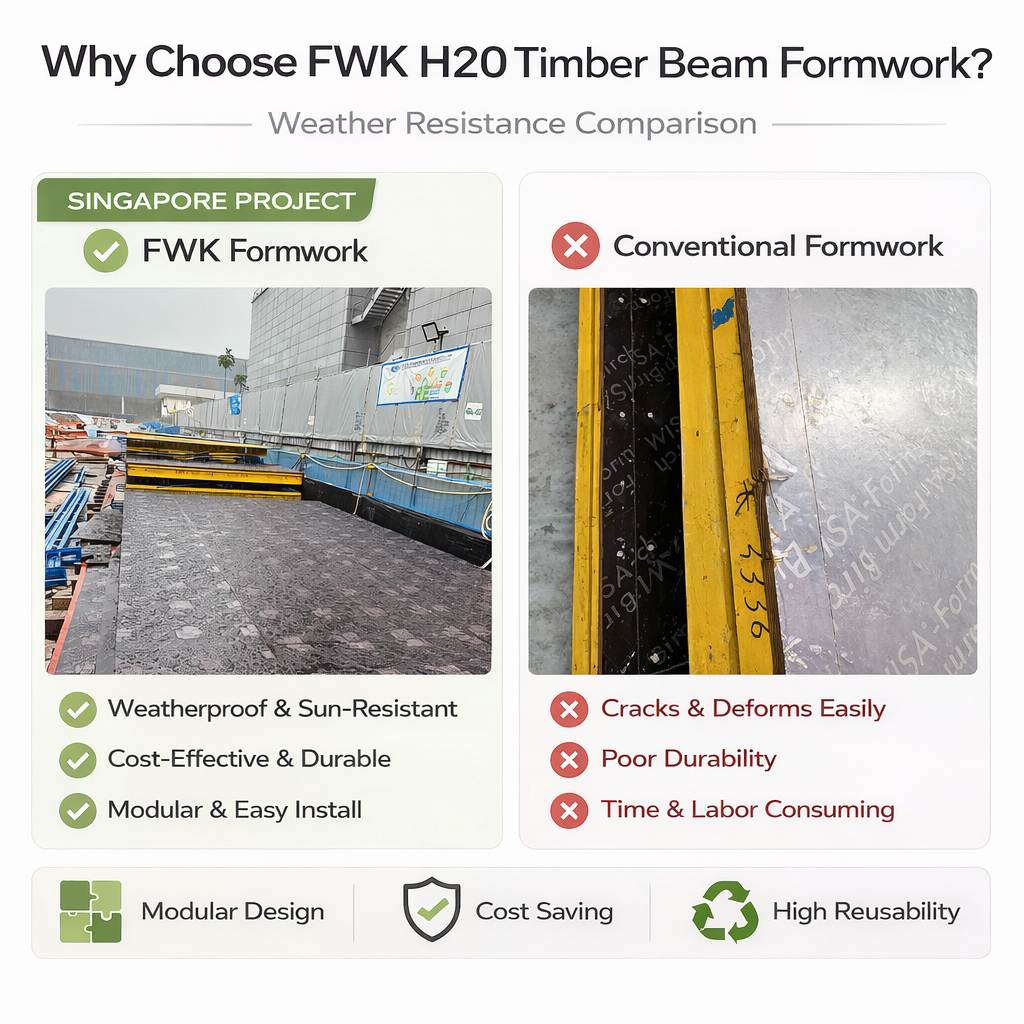
Turnover rate
FWK reports a turnover rate of about 26-40 times for its H20 beams and panels, with double-sided usability. Conventional H20 timber beam formwork is reported at 5-8 times, single-sided only. For a project with repeated wall or slab pours, this difference can change the economic decision.
Cost and maintenance
FWK's data frames its H20 system as offering dual service life with a single purchase and high reusability. The conventional system, although it may have a lower initial purchase price, has a short service life and total cumulative cost that is described as far exceeding the FWK system. On maintenance, the FWK H20 system resists direct sunlight at a normal outdoor temperature of 35°C, does not blister after rainwater evaporates, and only needs a release agent for daily use. Conventional H20 is reported to deform and bend at 35°C, blister after exposure to rain, and gradually peel off after three uses.
Installation efficiency and concrete finish
Quick manual cutting and installation are key features of FWK's H20 system. It supports on-site fabrication of irregular shapes, high turnover efficiency, and high flexural strength, and it meets requirements for fair-faced concrete formwork. Conventional H20 timber beam formwork is reported to have slightly lower flexural strength and a higher risk of delamination under high temperature.
Detailed Solution: FWK B-FORM vs Conventional B-FORM
B-FORM refers to steel frame formwork panels assembled with laminated boards. FWK Lianggong's B-FORM is described as a high-strength, rapidly installable, mobile, flexibly adjustable system with high load-bearing capacity and a high-strength steel frame combined with laminated board. Conventional B-FORM is described as primarily composed of plywood with a simple steel frame; it is heavier, has relatively lower load-bearing capacity, and uses standard plywood.
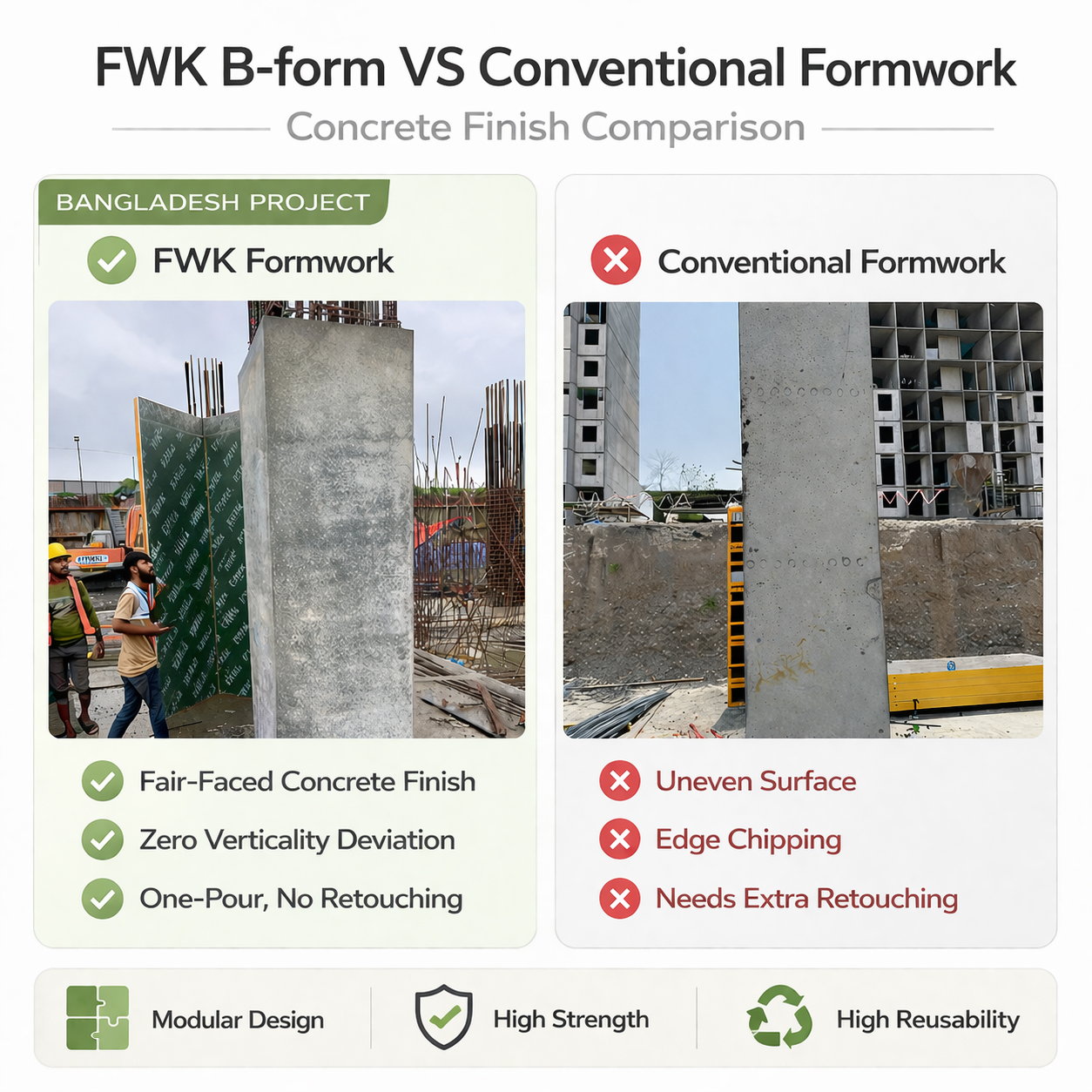
Turnover rate
FWK states that its B-FORM panel can be used 20-40 times depending on the model, and the steel frame can be used more than 100 times. Conventional B-FORM is reported at 15-30 panel uses and 50+ steel frame uses.
Installation speed
FWK B-FORM is modular, pre-assembled, and positioned as a complete unit. It is designed to be operated by one person, with no repeated adjustments required. The documented installation speed is 20-25 m² per person per day. Conventional B-FORM, by contrast, uses loose assembly, piece-by-piece installation, on-site matching, and repeated adjustments, with installation speed of 12-15 m² per person per day.
Maintenance and long-term cost
FWK B-FORM's sturdy steel frame and durable panels correspond to annual maintenance cost below 5%. Its standardized components are designed for easy replacement, with nearly zero replacement required. Conventional B-FORM is reported with annual maintenance cost above 15%, because plywood is prone to deformation and cracking, and low-strength components are susceptible to damage. Although conventional B-FORM may have a lower first cost, cumulative replacement expenses tend to make long-term costs higher.
Use Cases: Choosing the Right System Family
FWK H20 timber beam formwork is best suited to:
- Special-shaped component construction
- Medium-scale engineering
- Large-area horizontal structures
- Residential building construction
- Sites that need rapid on-site fabrication of irregular shapes
FWK B-FORM is best suited to:
- High-rise and super high-rise buildings
- Core walls and shear walls
- Columns and variable cross-section wall projects
- Projects with high requirements for concrete appearance, verticality and flatness
Conventional H20 remains a low-cost option for small-scale engineering, civil housing, scattered assembled non-standard structures, and other projects with low quality requirements. Conventional B-FORM can satisfy standard requirements for high-rise buildings, columns and walls where concrete appearance and flatness requirements are standard rather than demanding.
Step-by-Step Breakdown: A Framework for the Final Supplier Comparison
- Define the structural scope. Identify walls, slabs, columns, core walls, and any special-shaped or variable cross-section elements.
- Estimate reuse cycles. Calculate how many times each formwork panel and beam will be used across the project portfolio, not just one project.
- Model total cost. Include purchase price, delivery, maintenance, replacement panels, release agent, labor cost, and the cost of schedule delays.
- Compare installation efficiency. Use documented rates such as m² per person per day to estimate crew size and program duration.
- Assess maintenance and site risk. Review storage requirements, cleaning rules, repair procedures, and the supplier's inspection protocol.
- Verify compliance. Ask for current certification documents relevant to the delivery country, such as ANSI/ASSP A10.9 or EN 12812 requirements.
- Request evidence. Ask for sample panels, factory inspection reports, model numbers, and a written quotation that matches the project schedule.
Comparison Table: FWK Lianggong vs Conventional Systems
| Comparison Metric | FWK H20 Timber Beam Formwork | Conventional H20 Timber Beam Formwork | FWK B-FORM | Conventional B-FORM |
|---|---|---|---|---|
| Material characteristics | Lightweight, standard dimensions, high density, wear and high-temperature resistance | Non-standard dimensions, non-multilayer board, inferior film coating | High-strength steel frame + laminated board | Plywood + simple steel frame |
| Turnover rate | About 26-40 times; double-sided use | 5-8 times; single-sided use | Panel 20-40 times; frame 100+ times | Panel 15-30 times; frame 50+ times |
| Installation speed | Quick manual cutting and installation; high flexural strength | Lower flexural strength; delamination risk at high temperature | 20-25 m² per person per day; single-operator capable | 12-15 m² per person per day; repeated adjustments |
| Maintenance cost | Only release agent for daily use at normal temperature; no blistering after rain evaporation | Deforms at 35°C; blisters after rain; peels after three uses | Annual maintenance below 5%; standardized components | Annual maintenance above 15%; plywood deformation and cracking |
| Cost profile | Dual service life with a single purchase; high reusability | High initial cost plus short service life; higher cumulative cost | Higher initial investment; reusable across projects and years | Lower upfront cost; cumulative replacement expenses higher |
| Best-fit applications | Special-shaped structures, medium-scale engineering, large horizontal structures, residential buildings | Low-cost small-scale engineering, civil housing, non-standard structures | High-rise or super high-rise, core walls, shear walls, columns, variable cross-section walls | Standard high-rise buildings, columns and wall projects |
Operational Risk Control: What to Demand from a Formwork Supplier
Formwork failures usually come from small and repeated issues: panel peeling, joint mismatch, frame deformation, rust, or careless stripping. FWK Lianggong's published risk-control documentation describes a Three Inspections and One Review system. This includes production inspection, quality inspection, factory inspection, and a final acceptance re-check before shipment. For B-FORM, the documented control measures include cleaning and coating panel surfaces before and after use, avoiding contact and friction with rebars, immediate replacement of cracked panels, supporting steel frames on at least three cushion points when stacking, limiting stack height to 18 frames, and prohibiting metal tools from striking the steel frame. Deformation at joints can be corrected by reverse pressure or by an expander with external clamping and internal support. For H20 timber beam formwork, the documented risk controls include moisture-content inspection on warehouse entry, on-site fire protection zoning, a turnover-cycle ledger, and load-bearing capacity acceptance. These measures matter because timber beams are susceptible to moisture-induced deformation, are flammable, and can have a high turnover loss rate if not tracked. When comparing suppliers, ask for their inspection protocol, not just their product brochure. A supplier that can describe stage-by-stage inspection and repair procedures is easier to audit during production and at the yard.
FAQ
1. What compliance and certification checks should be part of formwork procurement?
For concrete and masonry work in the United States, formwork design and erection safety are governed by ANSI/ASSP A10.9-2013 (R2018). In Europe, EN 12812:2008 specifies performance requirements and general design for falsework or shoring. A verified supplier profile lists FWK Lianggong Formwork with CE (EN 1090-1), ISO 9001 and ISO 3834 certification; buyers should request current certificates before ordering.
2. How do FWK Lianggong H20 and B-FORM systems differ from conventional systems in performance?
FWK H20 timber beam formwork is reported with a turnover rate of about 26-40 times with double-sided usability, versus 5-8 times single-sided for conventional H20. FWK B-FORM uses a high-strength steel frame with laminated panels, achieves 20-40 panel uses and 100+ steel frame uses, and installs at 20-25 m² per person per day, versus 12-15 m² for conventional B-FORM.
3. Is the higher initial investment justified for FWK systems compared with conventional formwork?
The comparison data indicates dual service life for FWK H20 and long-term reuse for FWK B-FORM. Conventional H20 is described as having a high initial cost combined with shorter service life, resulting in higher cumulative cost. Conventional B-FORM has lower upfront cost, but the data reports annual maintenance cost above 15%, while FWK B-FORM is below 5%.
4. How can I request product samples or a quote?
FWK Lianggong Formwork offers off-the-shelf and customized products and welcomes OEM and ODM orders. For sample or quotation requests, contact David Liu at sales01@lianggongform.com or WhatsApp +86 18201051212. The company brochure is available for download from the link at the end of this article.
5. What should buyers check when evaluating lead time?
Lead time depends on production scheduling, material availability and project scope. FWK Lianggong's company profile lists 230 employees, a 12,870 m² factory, 12,000 tons of annual output and a 70% export ratio; a verified supplier profile also cites an annual capacity of 8 million m². Buyers should confirm current production windows and delivery terms with the supplier.
Conclusion: The Decision Is About Lifecycle Cost and Risk, Not Just First Price
Whether a project is better served by H20 timber beam formwork or steel frame formwork depends on structure type, reuse cycles, labor productivity, finish requirements and maintenance capacity. The FWK Lianggong comparison data is useful because it quantifies the difference: H20 turnover of 26-40 times versus 5-8 times for conventional H20; B-FORM installation of 20-25 m² per person per day versus 12-15 m²; annual maintenance below 5% versus above 15%. These are the metrics that turn a simple price comparison into a lifecycle cost decision. FWK Lianggong Formwork (Yancheng Lianggong Formwork Co., Ltd.) produces both systems and supports export buyers with a 12,870 m² factory, 230 employees, 12,000 tons of annual output, a 45-person R&D team, and a 70% export ratio. Buyers can request current drawings, samples and quotations directly from the company.
Next step: Visit the FWK Lianggong Formwork website or download the FWK Lianggong Formwork brochure to review the full product range and factory capabilities. For a project-specific comparison, contact David Liu at sales01@lianggongform.com or WhatsApp +86 18201051212. FWK is located at No. 8, Shanghai Road, Economic Development Zone, Jianhu County, Yancheng City, Jiangsu Province, China.
Have Questions or Need More Details?
Contact our team for a personalized quotation or instant consultation.
Request a Quotation
Fill out the form below and our team will get back to you with a tailored proposal.
WhatsApp Direct Chat
Prefer to chat in real-time? Message us on WhatsApp for instant assistance & quick answers.
- Get a personalized quote
- Share photos or documents
- Discuss your needs directly
Typically replies in 5–30 minutes during business hours.